

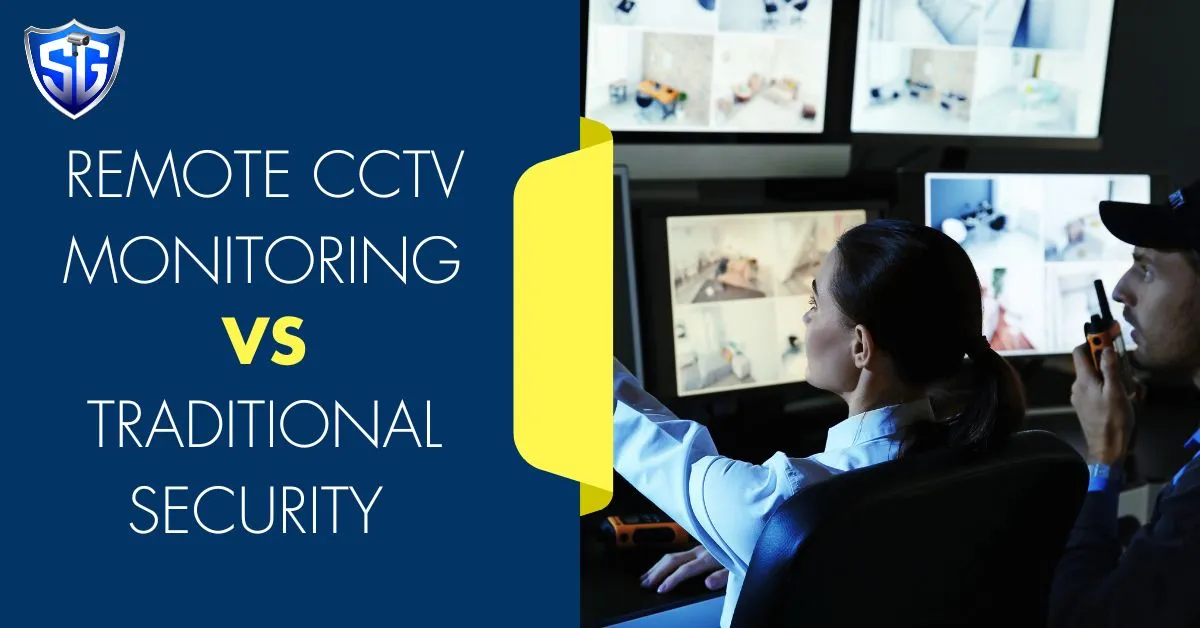
Security is a top priority for both homeowners and businesses. For decades, traditional security guards and basic CCTV systems were considered enough. But today, threats have evolved—and so has technology.
As a result, Remote CCTV Monitoring has quickly become the smarter, faster, and more cost-effective solution for modern security challenges.
In this comparison, we break down both systems to help you understand which one truly offers better protection. (Spoiler: Remote CCTV Monitoring wins by a wide margin.)
What Is Traditional Security?
Traditional security relies on:
- On-site security guards
- Physical patrols
- Basic CCTV cameras that only record, not monitor
- Manual decision-making during incidents
While this method offers a physical presence, it has limitations such as high costs, human error, and restricted coverage.
What Is Remote CCTV Monitoring?
Remote CCTV monitoring uses:
- Real-time camera surveillance
- Off-site trained security operators
- Motion sensors, alarms, and AI analytics
- Instant alerts and faster response times
Instead of waiting for incidents to happen, the system detects and prevents them before they escalate.
Remote CCTV Monitoring vs. Traditional Security: Head-to-Head Comparison
1. Cost Efficiency
Traditional Security:
- Expensive guard salaries
- Additional costs for multiple shifts
- Overtime, uniform, and recruitment expenses
Remote CCTV Monitoring:
- Fixed monthly or annual fee
- Covers 24/7 monitoring
- No staffing or HR challenges
Winner: Remote CCTV Monitoring — Cuts security costs by up to 60%.
2. Coverage & Visibility
Traditional Security:
- Guards can only be in one place at a time
- Blind spots and missed incidents are common
Remote CCTV Monitoring:
- Monitors multiple locations at once
- Full view of every entrance, corner, and blind spot
- Uses night vision, thermal cameras, and sensors
Winner: Remote CCTV Monitoring — Offers wider, uninterrupted coverage.
3. Response Time
Traditional Security:
- Guards take time to reach an incident
- May miss events happening out of sight
Remote CCTV Monitoring:
- Remote team sees incidents instantly
- Can trigger alarms or contact police immediately
- Can even talk to intruders through speakers
Winner: Remote CCTV Monitoring — Faster, real-time action.
4. Reliability & Human Error
Traditional Security:
- Fatigue and distractions can reduce effectiveness
- Guards can be overwhelmed or outnumbered
Remote CCTV Monitoring:
- Operators work in shifts
- AI helps detect suspicious behavior
- No risk of fatigue or physical distraction
Winner: Remote CCTV Monitoring — Consistent and reliable 24/7.
5. Crime Prevention
Traditional Security:
- Mostly reactive
- Responds after something happens
Remote CCTV Monitoring:
- Proactive, prevents incidents before damage
- Uses audio warnings to scare intruders
- Alerts police faster than guards
Winner: Remote CCTV Monitoring — Stronger prevention capability.
6. Scalability
Traditional Security:
- Requires more guards for larger sites
- Expensive and difficult to manage
Remote CCTV Monitoring:
- Add more cameras without increasing staff
- Easily scale across multiple sites
Winner: Remote CCTV Monitoring — Perfect for growth and multi-location businesses.
Final Verdict: Remote CCTV Monitoring Is the Clear Winner
While traditional security has been useful for decades, it simply cannot match the speed, efficiency, coverage, accuracy, and cost savings offered by remote CCTV monitoring.
Why Remote CCTV Monitoring Wins:
- 24/7 real-time monitoring
- Faster response to threats
- Lower costs and higher ROI
- Zero blind spots
- AI + human intelligence for smarter security
- Works for both homes and commercial properties
Whether you’re a homeowner or a business owner, Remote CCTV Monitoring provides superior protection with modern technology at a fraction of the cost.